
EduSAF Work Packages
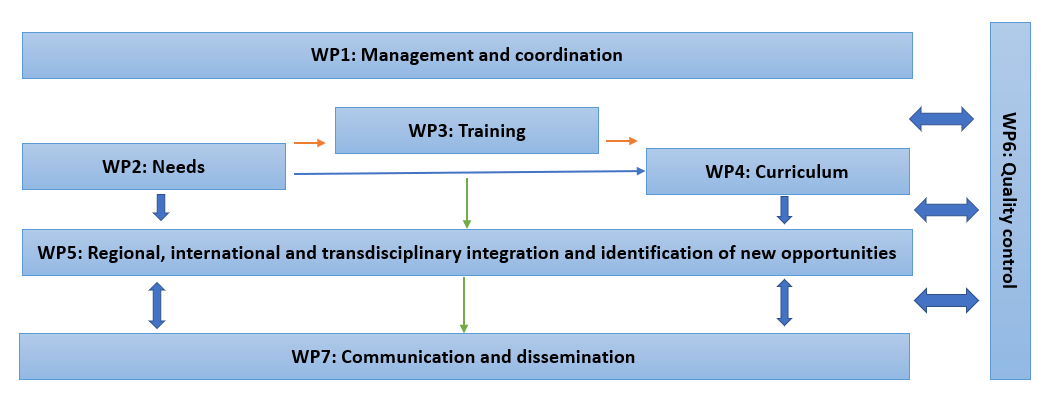
Management and coordination
Objetives:
- To make all administrative and management decisions in an informed and structured manner.
- To oversee all activities and ensure that they are carried out and that the results are met throughout the project.
- To ensure that each partner is fully committed to the project and fulfils their responsibilities.
- To anticipate potential risks in order to mitigate them appropriately, including disagreement between partners and dispute settlement.
- To supervise the proper use of resources to ensure that the project is carried out in the most cost-effective manner.
Tasks:
T1.1 – Creation of the Project Management Team and the project administration manual
The Project Management Team (PMT) will be made up of a representative of each participating HEI. The project management manual will be drafted and shared with all partners and approved at the kick-off meeting.
T1.2 – Project coordination meetings
The PMT will meet twice a year in person (six times in total), coinciding with meetings on other tasks to maximise profitability. These meetings correspond to Events E1.1, E1.2, E2.1, E3.2, E3.3, E4.1 and E5.1.
T1.3 – Operational and financial reports
Communications and reports are to be submitted to the EC Project Officer.
Analysis of the needs of the environment and Latin American HEIs
Objectives:
- To identify the actual needs of the relevant social actors, including producers, businesses, local and regional associations, and government agencies in the region across the following 4 thematic areas: a) the environmental impact and sustainability of activities and processes within the agrifood system; b) resilience to the effects of climate change; c) use of appropriate technologies to enhance processes considering contexts and knowledge; d) training requirements with regard to labour market demand.
- To identify the needs of Latin American HEIs to implement the necessary curricular changes that will enable them to respond to the social needs identified above.
- The first objective (needs of the environment) is intended to guide curricular updates to maximise impact in the region, while the second (needs of HEIs) will serve to optimise the teacher training courses in the next work package.
Tasks:
T2.1 – Identification of social actors
This task will consist of mapping and identifying relevant social actors, including the productive sector, municipal and community associations, and the government sector in order to disseminate the project’s objectives effectively and encourage their engagement in the planned activities.
T2.2 – Design of workshops to identify the needs of the environment
Workshops will be developed in hybrid format (face-to-face and on-line) to encourage the participation of all relevant social actors. This will include training the organisers in workshop dynamics and methodologies, planning workshop activities, selecting appropriate venues with the necessary infrastructure, and issuing calls for participation.
T2.3 – Workshops with socioeconomic actors
At least two one-day workshops will be conducted in each of the participating Latin American HEIs involving the relevant social actors identified in T2.1. These workshops will follow the design and methodology developed in the previous task (T2.2).
T2.4 – Needs diagnosis
The needs identified during the workshops will be analysed together with the level of maturity in the use of digital technologies within the local and regional food production ecosystem, including local and rural communities, farms, industry, and commerce. This task will also involve the initial drafting of the report (D2.1).
T2.5 – Needs of HEIs The situation of Latin American HEIs will be determined, concerning the needs identified by social actors, using strategies such as SWOT analysis to plan staff training actions and curricular updates. This task will conclude with the final Report (D2.2).
Training sessions for teachers and researchers
Objectives:
To prepare the teaching staff of Latin American HEIs to design the curricular changes required to meet the needs identified in Work Package 2 in the project’s thematic areas: environmental sustainability and assessment of the impact of agrifood systems through life cycle assessment; resilience to the effects of climate change; and use of digital tools and green technologies to improve the agrifood system.
Tasks:
T3.1 – Teacher Training Course 1: Sustainable Food Systems: Challenges and Opportunities of the Farm to Fork Strategy
Design, organisation, delivery of the course and subsequent quality assessment through satisfaction surveys conducted by UGent. The final content will be adapted according to the needs identified in D2.1 with the collaboration of UdelaR. Hybrid modality: face-to-face in Ghent (Belgium) with the option of online participation.
T3.2 – Teacher Training Course 2: Digital Technologies for Industry 4.0.
Design, organisation, delivery of the course and subsequent quality assessment through satisfaction surveys conducted by CIHEAM and VUB. The final content will be adapted according to the needs identified in D2.1. Hybrid modality, face-to-face in Montevideo (Uruguay) with the option of online participation. UdelaR will be in charge of the allocation of places, welcome and local organisation.
T3.3 – Teacher Training Course 3: Global Food Systems and their Environmental Impact.
Design, organisation, delivery of the course and subsequent quality assessment through satisfaction surveys conducted by UPorto. The final content will be adapted according to the needs identified in D2.1. Hybrid modality: face-to-face in Porto (Portugal) with the option of online participation.
T3.4 – Teacher Training Course 4: Agroecological Production, Responsible Consumption, Waste Management, Agriculture 5.0, and Resilience to Climate Change.
Design, organisation, delivery of the course and subsequent quality assessment through satisfaction surveys conducted by CIHEAM and VUB. The final content will be adapted according to the needs identified in D2.1 in collaboration with UMSS. Hybrid modality, face-to-face in Montevideo (Uruguay) with the option of online participation. UdelaR will be in charge of the allocation of places, welcome and local organisation.
T3.5 – Teacher Training Course 5: Food Consumption Patterns and Consumer Choices Shaping Sustainable Food Systems.
Design, organisation and delivery of the course and subsequent quality assessment through satisfaction surveys conducted by UPorto. The final content will be adapted according to the needs identified in D2.1. Online modality.
Expansion of the training offer of Latin American HEIs
Objectives:
To improve the training offer by updating curricula and practice laboratories, aimed at the development of competencies, skills, and critical thinking of graduates in relation to the environmental impact of agrifood processes, understanding of agrifood systems, resilience to climate change, use of appropriate technologies, and training requirements with regard to labour market demand taking into account local contexts and knowledge. The training offer will seek to develop self-directed learning skills, critical thinking, entrepreneurship, and a closer connection to the social and labour context of the region through transdisciplinary education processes. This will include innovation days, internships in real-world settings, workshops delivered by professionals outside the academic community and equipping of specialised laboratories. It will seek to facilitate university education for groups with fewer opportunities: students with neurodevelopmental disorder (Asperger’s and autism), students from remote areas, students with low economic resources and students from indigenous communities (Quechua and Aymara, among others).
Tasks:
T4.1 – Generation of content and courses that address sustainability of agrifood chains, energy transition, environmental impact assessment.
Depending on the training carried out by the teachers and on graduates’ needs of new content and skills, additional courses will be developed to be taught in Latin American HEIs, to address topics including new digital technologies, life cycle, water footprint, carbon footprint, circular economy, waste management and consumption patterns.
T4.2 – Development of optional courses with mixed teaching methods
Optional courses will be designed using a blended learning approach, inviting professionals from the socio-productive environment to contribute to the teaching. This will enable Latin American HEIs and their support entities to disseminate the innovation generated both within and outside the HEIs through incentives and acceleration of innovation programmes, to enable the exchange of experiences and facilitate the evaluation of the models adopted and their outcomes.
T4.3 – Generation of content and courses that address the implementation of new technologies (Industry 4.0) and alternative models.
New courses will be designed, based on the training carried out by teachers considering local, regional and national contexts such as the level of technological adoption and environmental impact. They will incorporate the concepts of artificial intelligence and data science, as well as alternative models of food production and transformation.
T.4.4 – Adaptation of existing curricula
This will allow the integration of the optional courses generated with the gradual and transversal development of the competencies mentioned previously. The feasibility of incorporating these new courses into existing curricula with the necessary modifications will also be analysed.
T4.5 – Design of course materials for a new study programme in agroecological production
A proposal will be made for some Latin American HEIs to introduce courses on sustainable production and responsible consumption, incorporating concepts of dialogue of knowledge that encourage interscientific dialogue and the exchange of academic knowledge and knowledge of indigenous communities and peoples. As part of this initiative, workshops on agroecology and dialogue of knowledge will be organised.
T4.6 – Design and implementation of innovation days/problem-solving workshops
An innovation day (12 to 24 hours) will be organised to bring together students and teachers from all Latin American HEIs. They will be divided into teams to address topics previously identified by the socio-productive actors and work on issues such as problem-solving. This task will enhance the development of competencies in communication and self-directed learning and knowledge management as well as professional performance in a transdisciplinary and multicultural environment.
T4.7 – Improvement of practice laboratories
Student laboratories will be modernised in all participating Latin American HEIs through the acquisition and installation of new equipment. To ensure their usability before the end of the project, at least one practice will be carried out with students before the completion of the project. Surveys will be conducted among teachers and students to assess the impact and added value of the new equipment.
Regional, international and transdisciplinary integration and identification of new opportunities
Objectives:
To promote integration, transdisciplinarity and the exchange of information, knowledge, experiences and best practices in the region, in order to create synergies between academia and the socioeconomic sectors of the agrifood system and to achieve the durability of the actions after the project’s completion.
To strengthen the internationalisation process by promoting international scientific cooperation on the subject of the life cycle of agrifood processes.
Tasks:
T5.1 – Identification of new opportunities based on the information shared through the platform
Identification of new opportunities and sectors in which new technologies and/or alternative models of production and processing can be implemented and can generate innovative projects. Strengthening and articulation of the capacities of HEIs and public and private institutions (social actors).
T5.2 – Design, development and management of activities to promote mutual knowledge and interaction
Organisation of co-creation workshops to expand the vision of the university/student/environment relationship based on the experience of other countries or regions with a diverse range of contexts.
T5.3 – Workshop with companies and governmental and non-governmental organisations
Promotion of the co-creation of change regarding concepts of sustainability, energy transition and circular economy.
T5.4 – Creation of opportunities for sharing and exchanging knowledge on specific topics among professor-researchers of the HEIs
Organisation of meetings/conferences/workshops to promote scientific cooperation and synergy of knowledge.
T5.5 – Creation of a database with common or complementary lines of research of the participating HEIs
Collection of information from the entities involved, lines of research, researchers, publications on common lines of research.
T5.6 – Identification of mechanisms and/or channels that enable the presentation of bilateral or multilateral research projects
The partners of the different existing calls for the presentation of bilateral or multilateral research projects on topics of interest related to primary production and food processing will develop a dissemination programme.
T5.7 – Exchange of researchers and/or postgraduate students.
Where possible and if funding can be obtained through other projects or funds from the participating HEIs, exchanges of researchers and/or postgraduate students will be carried out. Funds are already available for 6-month stays of 5 students in the context of the MARCA project, which involves UNS and UDELAR.
T5.8 – Promotion of cooperation in the use of highly complex scientific equipment. Promotion of scientific cooperation and use of highly complex structures to develop scientific projects.
Evaluation and control of quality, impact and sustainability
Objectives:
To ensure the quality control of the project, and evaluate the impact and sustainability of the project outcomes.
Tasks:
T6.1 – Design of the Annual Evaluation Programme and Creation of the Quality Control Committee (QA)
Creation of the Quality Control Committee with representatives of all the institutions involved in the project. The Quality Assurance Officer, with the support of the Project Coordinator, will establish the procedures for evaluating the progress of the project, its intermediate and final results, through the development of a detailed Quality Assessment Programme.
T6.2 – Review of the QCC Annual Programme
Once a year, WP6 leader and co-leader will prepare the QCC Annual Evaluation Programme, including the corresponding activities developed during the project. In this task, a set of Quality Assurance Indicators will be developed that will be included in the Quality Assurance Plan.
T6.3 – Submission of the Annual Quality Control Programme to the rest of the working groups and uploading to the platform
The evaluation programme includes the work packages, the evaluation schedule and the evaluation team. At the beginning of the project, a common repository will be created to share all the relevant results and documents of the project.
T6.4 – Review of the course material
The course material will be reviewed together with each of the QCC evaluators of the institution to which they belong. The representatives of each institution may provide the members of the committee more details.
T6.5 – Development of a specific evaluation plan corresponding to each of the work packages (scope, deadlines, duration, evaluators, evaluees)
The Evaluation Plan will be prepared taking into account the scope, the evaluators, the evaluees and the deadlines. In the implementation stage, WP6 leader and co-leader will hold an opening meeting to present the criteria, methodology, and other pertinent aspects of the evaluation to the committee members, in the presence of the representatives of the WPs to be evaluated.
T6.6 – Creation of appropriate tools to execute internal and external audit programmes of work packages effectively
Audits will be supported by questionnaires, interviews, checklists and software. In addition, all the personnel working on the project will contribute to the monitoring reports to formalise all activities carried out throughout the project. All the reports will be distributed among the partners to continuously verify the quality of the process.
Communication and dissemination
Objectives:
Effective communication is an essential element in achieving the objectives of agrifood cooperation in terms of the dissemination and management of training activities and projects. It plays a key role in creating a coherent and unified brand identity and image, and in reinforcing the visibility and positioning of the project. Through strategic communication, the project aims to strengthen its positioning, increase its notoriety and expand its impact, ultimately ensuring broader outreach and long-term success.
Tasks
T7.1 – Project website design
Design and implementation of the project website.
T7.2 – Preparation of the dissemination plan
Work will be conducted on digital and conventional channels, content design and creation (news, photos, videos) for newsletters, websites, and landings, as well as for the main social media channels (LN, IG, X, FB, YT). Advertising campaigns will also be designed by generating printed material such as information sheets, leaflets, brochures or posters, mailings, merchandising, roll-ups, etc. Continuous work will be carried out with mainstream media and the agrifood sector, writing press releases or organising events targeting journalists. The project will participate in the dissemination and organisation of technical conferences, visits, conferences and other events, as well as its own events and those of third parties linked to the values of the project.
T7.3 – Preparation of project dissemination material
Dissemination material will include videos, promotional material, and activities on social media, among others.
T7.4 – Design, development and management of a publicly accessible digital platform for the exchange of experiences and best practices
Development and implementation of a publicly accessible digital platform containing information on successful experiences and best practices. Collection and updating of examples of successful experiences and best practices carried out in the participating HEIs. Establishment of the rules for information use and management.
T7.5 – MOOCs
All the educational and training material presented throughout the project will be compiled with the aim of preparing online self-learning modules that will be available on the project website. The training modules will include video recordings, slides with notes, and detailed documentation on the solutions developed within the framework of the project. CIHEAM Zaragoza will be responsible for the selection of topics and contents, and for coordination with teachers.
T7.6 – Final conference
A final conference will be organised to disseminate the results of the project after the project consortium’s final meeting.